Algo Trading Strategies: A Practical Guide for Indian Traders
Not long ago, algo trading was strictly a bank-and-hedge-fund thing. Then discount brokers started opening up their APIs, and suddenly any retail trader with a laptop could build — or buy — an automated strategy of their own. The pitch is straightforward: instead of staring at candles all day and pulling the trigger yourself, you write down your rules once and let a program follow them.

What’s trickier is figuring out which strategies are actually worth your time, how they work once you strip away the marketing, and what’s changed on the regulatory side now that SEBI has stepped in with a proper framework for retail algo trading. That’s what this piece is about.
So What Actually Is an “Algo Trading Strategy”?
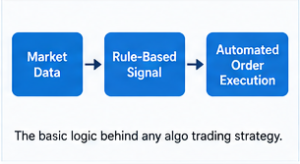
Strip away the jargon and it’s just this: a set of rules — built around price, volume, time, whatever — that tells a system when to buy, when to sell, and how much to risk on each trade. Code it once, and it runs without you clicking anything.

hat’s the whole trick. The “strategy” is the logic. The “algo” is just the automation wrapped around it. Some strategies are almost embarrassingly simple — “buy when the 20-day average crosses above the 50-day average” — and others get genuinely complicated, pulling in statistics, multiple instruments, even machine learning. More complexity doesn’t automatically mean a better strategy, either. Plenty of people are quietly making money with rules a first-year engineering student could code in an afternoon.. Complexity isn’t what makes a strategy good — plenty of profitable systems are built on fairly basic rules applied with discipline.

Common Types of Algo Trading Strategies
Most retail-accessible algo strategies fall into a handful of recognizable categories. Knowing the common categories below will get you a lot further than blindly subscribing to someone’s “black box” system and hoping for the best.
Trend-Following and Momentum Strategies
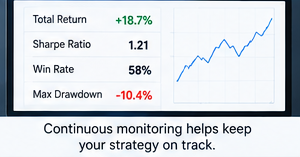
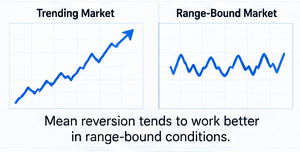
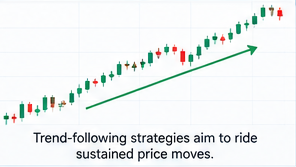
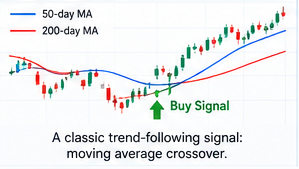
The bet here is simple: a stock or index moving hard in one direction tends to keep going for a while. People build this using moving average crossovers, breakout levels, or momentum indicators like RSI. It works nicely when the market actually trends. It gets ugly in a choppy, sideways market, where you’ll eat a bunch of small losses from signals that go nowhere.

Mean Reversion
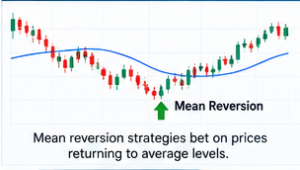
Basically the opposite bet — prices that have stretched too far in one direction tend to snap back. Buy the stock that’s been beaten down too hard, or short the one that’s rallied too fast on no real news. This does well when the market is stuck in a range. It falls apart when what looked like an overextension turns out to be the start of an actual trend, and you end up fighting the tape.

Arbitrage
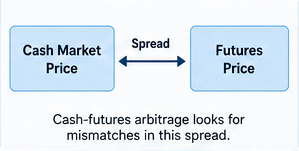
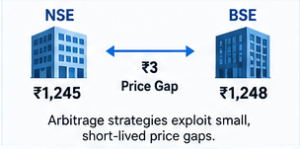
This is about tiny price gaps — the same stock trading slightly differently on NSE versus BSE, say, or a stock’s price drifting away from its futures price. The gaps are small and they close fast, which is why the big, well-funded players eat most of this space. Retail traders can still play in simpler corners of it, like cash-futures arbitrage, but don’t expect fat margins, and speed matters more here than almost anywhere else.
Pairs Trading (Statistical Arbitrage)
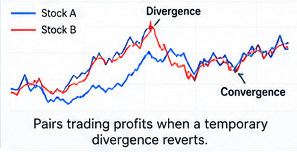
One level up in complexity: find two stocks that normally move together — two large private banks, for instance — and trade the gap between them when it drifts unusually far from normal, betting it closes again. The strategy is to buy the underperforming asset and short the stronger one, then wait for the gap between them to narrow. This needs solid statistical grounding and ongoing monitoring, since correlations between stocks can break down for genuine business reasons.

Market-Making
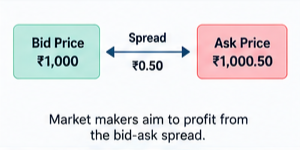
Market makers sit on both sides of the order book — buying and selling around the current price — and try to pocket the spread. It takes low latency, tight risk controls, and enough capital to sit on inventory you didn’t necessarily want. This is mostly proprietary-desk territory, though some advanced retail setups borrow bits of the idea on very liquid names.
It’s more common among proprietary trading firms than individual retail traders, though some advanced retail systems borrow elements of it on liquid, high-volume stocks.

Scalping
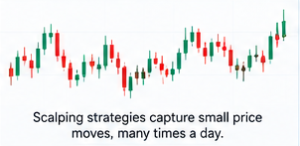
Lots of tiny, fast trades instead of a few big ones. Tight spreads and quick execution matter enormously here, because brokerage and slippage chew through your edge far faster than they would in a slower strategy. Works better on liquid stuff like index futures than on a thinly traded small-cap where every order moves the price.
Scalping tends to suit highly liquid instruments like index futures more than thinly traded small-cap stocks.

Event-Driven Strategies
These strategies react to scheduled or breaking events — earnings announcements, RBI policy decisions, index rebalancing, or budget days — where volatility and price moves are expected to be sharper than usual. Building a reliable event-driven strategy is harder than it sounds, since the market often reacts to how a result compares with expectations rather than to the result itself.

How Traders Actually Build and Test a Strategy
Before any strategy touches real money, it typically goes through a few stages:
- Idea and hypothesis: A clear, testable rule — not just a vague feeling that “this pattern usually works.”
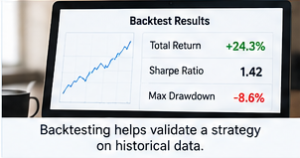
- Backtest it : against historical data, and actually look at the drawdowns, not just the headline return number.
- Paper trade it : for a while, so you can see if it behaves the same way live as it did on old data.
- Small live deployment: Starting with a small amount of real capital and gradually scaling up only if performance and risk controls hold up.
Backtesting is where a lot of retail traders go wrong. It’s easy to unintentionally curve-fit a strategy so it looks great on past data but falls apart going forward, especially if you keep tweaking rules until historical results look good. A strategy that only works on one narrow historical period, or on one specific stock, deserves extra skepticism.
India’s Regulatory Framework for Retail Algo Trading
This part matters more than it used to. EBI put out a circular back in February 2025 laying out a full framework for retail algo trading. It didn’t land all at once — brokers started registering retail algo products with exchanges from October 2025, non-compliant brokers got cut off from onboarding new API clients starting January 2026, and the whole thing becomes mandatory for every stockbroker from April 1, 2026.
What it means in practice: algorithms have to be registered before they can trade, brokers are on the hook as the responsible party for every algo running through their platform, and anyone providing algo strategies — a SaaS company, an independent coder, whoever — has to go through a registered broker instead of plugging straight into the exchange. From April 1, 2026, every order placed by an algorithm must also carry an exchange-assigned identifier so that unusual activity can be traced back to the specific algorithm that generated it.

For an ordinary retail trader, this doesn’t mean algo trading has become illegal or that you personally need to file paperwork with SEBI. Algo trading remains completely legal for retail investors, and in most cases retail traders don’t need to directly register their strategy with SEBI — the broker typically handles compliance, including assigning the unique strategy identifier. What it does mean is that the era of anonymous, unregulated “black box” algo subscriptions with no accountability is closing. If a platform or vendor can’t clearly explain which registered broker they operate through, that’s a reasonable reason to be cautious.
This tightening followed some real problems. SEBI’s own research found that net losses for individual F&O traders widened sharply in FY25, and unregulated algo platforms — many of them offering opaque “black box” strategies with no backtesting disclosures or accountability — made the situation worse. The new framework is meant to address that gap, not to shut retail traders out of automation altogether.
Tools and Platforms Indian Traders Typically Use
Retail algo trading in India generally happens through one of three routes, each with a different tradeoff between control and convenience.
Broker APIs. Almost every major discount broker gives you API access at this point, so you can wire your own Python code straight into your trading account. Total control, but also total responsibility — you’re writing it, testing it, and dealing with it when the connection drops mid-trade.
No-code or low-code strategy builders. Pick your indicators and conditions from a menu, no coding required. Lower barrier to entry, but it can get harder to know exactly what’s happening under the hood — which matters a lot the day the strategy starts doing something you didn’t expect.
Third-party algo marketplaces. Some platforms let you subscribe to strategies built by other traders or vendors. Under SEBI’s current framework, any such provider is expected to operate through a registered broker rather than connecting to exchanges independently. Before subscribing to any strategy like this, it’s worth asking what the strategy’s logic actually is, what its historical drawdowns looked like (not just its returns), and how it performed across different market conditions — not just during a favourable stretch.
The underlying ideas don’t change no matter which route you pick. A moving-average crossover is the same strategy whether you typed the Python yourself or clicked it together from a dropdown.
Picking a Strategy That Actually Suits You
There’s no “best” algo trading strategy floating out there waiting to be discovered — what fits depends on how much capital you have, how much time you can actually spend watching it, and how much of a drawdown you can stomach without doing something rash. A few things worth being honest with yourself about:
- If you can’t explain in plain words why a strategy should make money, don’t run it with real capital yet.
- Strategies that performed brilliantly on a single stock or a short historical window deserve more testing, not more confidence.
- Costs bite harder the more often you trade — scalping eats far more in brokerage and slippage than something slower ever will.
- Position sizing and stop-losses will decide whether you’re still around in a year far more than your entry signal will.
The Mistakes That Keep Showing Up
A few patterns show up repeatedly among newer algo traders:
- Over-optimizing on historical data until a strategy is essentially memorizing the past rather than capturing a real pattern.
- Ignoring transaction costs in backtests, which can turn a “profitable” strategy into a losing one once brokerage and slippage are included.
- Running someone else’s strategy blind, without understanding its logic or knowing when it’s likely to underperform.
- Skipping risk management, treating position sizing and stop-losses as optional rather than core parts of the system.
- Confusing a good backtest with a guarantee, when markets can and do behave differently going forward than they did historically.
Getting Started Responsibly
If you’re new to this, a reasonable path looks like: pick one simple, well-understood strategy type (trend-following and mean reversion are the most beginner-friendly to reason about); learn to backtest it properly, including realistic costs; paper trade it for a meaningful stretch of time across different market conditions; and only then commit a small amount of real capital, sized so that a losing streak doesn’t threaten money you actually need. Building this discipline matters more than finding a “secret” strategy — most publicly known strategy types are exactly that, publicly known, and any edge usually comes from execution and risk control rather than the basic idea itself.
Algo trading strategies aren’t a shortcut around the hard parts of trading — they’re a way to apply your rules consistently, without emotion, once you’ve actually done the work of building and testing them properly.
FAQs
Is algo trading legal for retail investors in India?
Yes. Algo trading remains fully legal for retail investors in India. SEBI’s 2025–2026 framework regulates how algorithms are registered and monitored through brokers; it does not ban retail participation.
Do I need to register my own strategy with SEBI?
In most cases, no. Your broker typically handles registration and compliance, including assigning your algorithm’s exchange-provided strategy identifier. Additional approvals may apply if your algo is high-frequency or offered commercially to other traders.
What’s the difference between algo trading and simply automating my own manual strategy?
There isn’t really a difference in principle — if you code your own trading rules and let a program execute them, that’s algo trading, whether the strategy is simple or complex.
Which algo trading strategy is best for beginners ?
There’s no single “best” one, but trend-following and mean-reversion are generally easier to understand and test than arbitrage or market-making, which demand more capital, speed, and infrastructure.
How much capital do I need to start algo trading in India ?
No fixed number — but starting small enough that you can afford to lose it matters more than starting big. Most traders scale up gradually once results hold up over time.
Can I still lose money even if my backtest looks profitable
Yes, easily. Backtests reflect the past, and they can be skewed by over-tuning, unrealistic cost assumptions, or the market simply behaving differently going forward. A solid backtest lowers your risk — it doesn’t erase it.
Do I need to know how to code to do algo trading?
Not strictly. No-code and low-code platforms exist. But knowing some basic programming — Python, usually — gives you far more control and a much clearer picture of what your strategy is actually doing.