Here’s the thing about scalping: the entry price, the target, even the setup itself — none of that matters as much as one boring number. How much are you willing to lose if this particular trade doesn’t work out?
Ask around and you’ll get a fairly consistent answer. Most traders who’ve been at this a while, and most of the risk-management writing out there, land somewhere between 0.5% and 1% of your trading capital per trade. Plenty of scalpers running fast, high-frequency setups push that even lower — 0.25% to 0.5% — simply because they’re in and out of the market so often that the math works against them if they’re not careful.
But a percentage by itself doesn’t tell you much. Let’s get into why scalping needs tighter risk control than, say, swing trading, how you actually turn a percentage into a real stop-loss and position size, and where people quietly blow up otherwise decent risk plans.
Why scalpers can’t afford loose risk limits
Scalpers take dozens, sometimes over a hundred, trades in a single session. That frequency changes the math of risk in two ways.
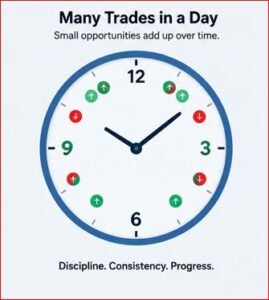
First, small errors compound fast. A swing trader who risks 2% per trade might take five trades in a month. A scalper risking the same 2% could take fifty trades in a week. If a losing streak hits — and losing streaks happen to every trader, including good ones — a higher per-trade risk gets multiplied by a much higher number of opportunities to lose.
Second, scalping margins are thin by design.
Most scalps aren’t big wins. You’re often working with a few points, sometimes just ticks, and the whole approach leans on doing this consistently — winning often enough, over and over — rather than landing one huge trade. That means a risk setting that’s even a little too aggressive can undo two or three weeks of careful, grinding gains in a single rough session.
The 0.5%–1% Guideline, Explained
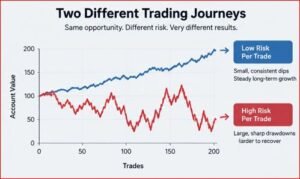
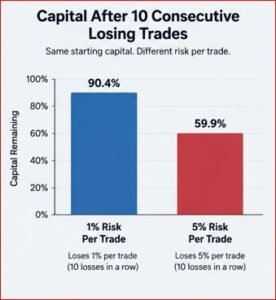
The idea behind capping risk at 0.5%–1% of capital per trade isn’t arbitrary. It comes from basic risk-of-ruin math: the smaller the percentage you risk on any single trade, the more consecutive losses your account can absorb before you’re in serious trouble.
Consider two traders, each with a fixed amount of capital:
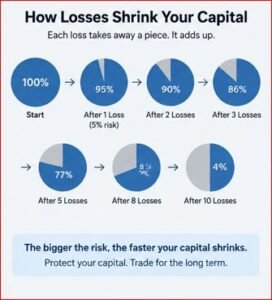
- Trader A risks 1% per trade. After 10 straight losses, they’ve lost roughly 9.6% of their original capital (because each loss is calculated on a shrinking balance).
- Trader B risks 5% per trade. After the same 10 straight losses, they’ve lost around 40% of their starting capital.
Trader B now needs a much larger percentage gain just to get back to even. That asymmetry — losses hurt more, proportionally, than equivalent gains help — is the entire reason risk-per-trade limits exist.
For scalpers specifically, because trade frequency is high, many professional and semi-professional traders push this even lower, often in the 0.25%–0.5% range, precisely because more trades mean more chances for a losing streak to show up.
How to Calculate Your Actual Risk Per Trade
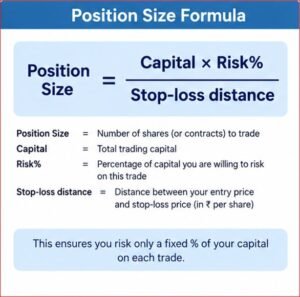
A percentage only becomes useful once it’s converted into real numbers: how many shares or lots you can buy, and where your stop-loss needs to sit. The calculation has three inputs.
- Total trading capital — the amount you’re actually deploying for intraday scalping, not your entire savings or investment portfolio.
- Risk percentage — your chosen limit, say 0.5% or 1%.
- Stop-loss distance — the gap, in rupees or points, between your entry price and your stop-loss.
The formula looks like this:
Position size = (Capital × Risk %) ÷ Stop-loss distance per share
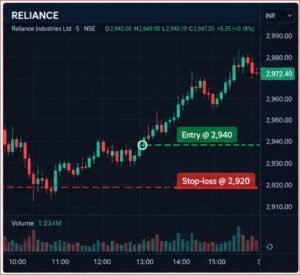
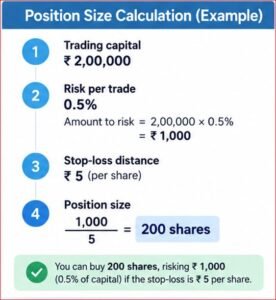
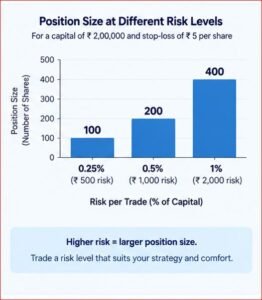
Say you’re working with ₹2,00,000 in trading capital and you’ve set your risk at 0.5% per trade. That’s ₹1,000 you’re putting on the line. If your stop-loss sits ₹5 away from where you’re entering, you can buy 200 shares — ₹1,000 divided by ₹5 — without stepping outside your own risk limit. Simple enough once you’ve done it a few times, though it’s easy to skip this step when you’re moving fast.
This is a more reliable way to size a position than deciding on a fixed number of shares or lots in advance and only then figuring out where the stop should go. When the position size is derived from the risk amount and the stop distance, the rupee risk stays consistent even as stop-loss distances vary from setup to setup.
Adjusting Risk for Volatility and Instrument
Not every instrument or session calls for the same stop-loss distance, which is why a fixed risk percentage still needs some judgment applied to it.
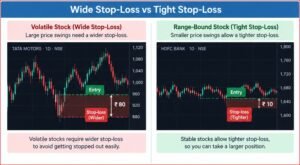
- Volatility changes the equation too. A stock that’s jumping around needs a wider stop, or normal price noise will knock you out of a perfectly good trade — which means you size down to keep your rupee risk where you want it. Something calmer and more range-bound lets you tighten the stop and take a bigger position for that same risk
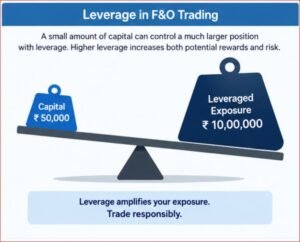
- F&O scalping adds another layer, since leverage means the same percentage risk on your capital controls a much bigger notional position. If you’re trading futures or options, you can’t just plug numbers into the basic formula — lot size and margin requirements need to factor in too.
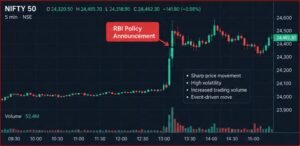
- News-driven or event sessions (results days, RBI policy days, major global data releases) often justify reducing size further, since spreads widen and price can gap past intended stop levels.
Daily and Weekly Risk Limits, Not Just Per-Trade Limits
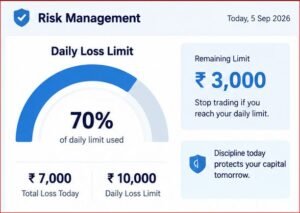
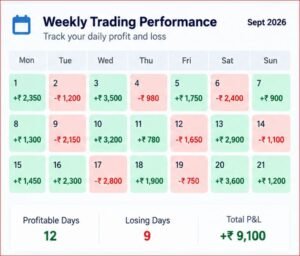
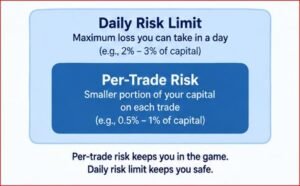
Per-trade risk is only one layer of a workable risk framework. Most serious scalpers, and most trading desks, also cap how much they’ll lose in a day — often 2% to 3% of capital — with a similar ceiling for the week. It’s a second layer of protection, because sticking to your per-trade risk doesn’t save you from a day where everything just goes wrong ten times in a row.
The logic is straightforward: if a trader risks 0.5% per trade but has an unusually bad day and takes ten losing trades in a row, that’s a 5% drawdown in a single session even while sticking to the per-trade rule. A daily stop — a rule that says “I stop trading for the day once I’ve lost X%” — protects against exactly this scenario, where individual trades were sized correctly but the cumulative effect of a bad session wasn’t capped.
This is also where discipline becomes more important than the number itself. A well-chosen risk percentage is only useful if it’s actually followed once a session starts going badly, which is often the hardest part for scalpers to stick to in practice.
Common Mistakes Indian Scalpers Make With Risk Sizing
A few patterns show up repeatedly among retail scalpers trading Indian markets:
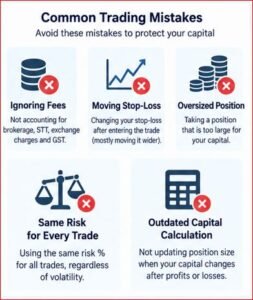
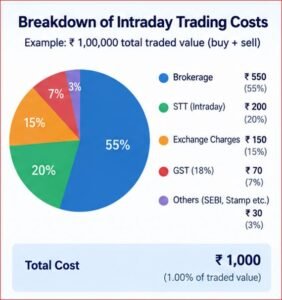
- Ignoring brokerage, STT, and slippage in the risk calculation. There’s also a cost problem that’s easy to overlook. Intraday trades in India come with STT, brokerage — yes, even with a discount broker — and exchange charges on both sides of the trade. On a scalp where your target is small to begin with, those costs can quietly chew through a good chunk of what you thought you’d made. None of that shows up if you’re only calculating risk off your stop-loss distance.
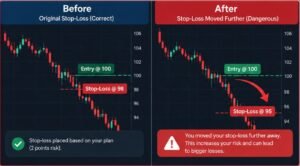
- Averaging down instead of respecting the stop. Moving a stop-loss further away after a trade goes against you effectively increases risk beyond the planned percentage, which defeats the purpose of calculating position size in the first place.

- One more habit worth breaking: using the exact same risk percentage on every trade no matter how confident you actually are in the setup. Not every trade deserves the same size. If a setup is shakier or the instrument’s more volatile, sizing down — even while staying inside your usual risk percentage — tends to make sense.
- And don’t forget to recalculate off today’s capital, not yesterday’s. After a losing session your balance is smaller, so the same percentage now means a smaller position. Skip that recalculation and you end up risking more, proportionally, than you meant to.After a losing session, capital is lower, so the same percentage translates to a smaller position size. Traders who don’t adjust for this end up risking a higher effective percentage than intended.
- Confusing margin available with capital at risk. Leverage from a broker increases buying power, not the amount a trader can safely afford to lose. Risk percentage should always be calculated on actual capital, not on the inflated exposure that margin allows.
Building a Simple Risk Framework
For a scalper setting up rules from scratch, a workable starting framework looks something like this:
- Decide on trading capital separate from long-term investments or emergency funds.
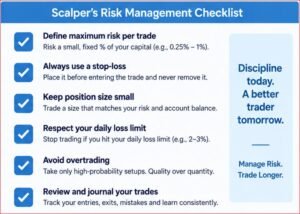
- Set per-trade risk at 0.5%–1% of that capital (many high-frequency scalpers lean toward the lower end).
- Set a daily loss limit around 2%–3% of capital, after which trading stops for the day regardless of setup quality.
- Recalculate position size before each trade based on current capital and the specific stop-loss distance for that setup.
- Track brokerage, STT, and other charges separately to see the real cost of each scalp, not just the price-based profit or loss.
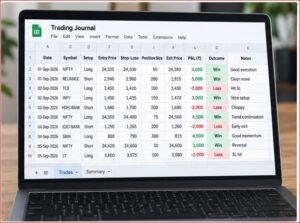
- Review risk adherence weekly — not just profit and loss — to catch drift toward oversized positions before it becomes a habit.
None of this guarantees profitability. Scalping remains a high-effort, high-attention strategy where transaction costs, slippage, and emotional discipline all play a large role in outcomes, and risk management is what determines how long a trader stays in the game long enough to find out if their strategy actually has an edge.
FAQs
1. Is 1% risk per trade too much for scalping? For many high-frequency scalpers, 1% is on the higher end. Because scalpers take many trades per session, a lot of practitioners cap risk closer to 0.25%–0.5% per trade specifically to limit the impact of losing streaks, which are more likely to occur given the trade frequency.
2. How do I calculate position size from a risk percentage? Multiply your trading capital by your chosen risk percentage to get your rupee risk amount, then divide that by the stop-loss distance per share (or per lot) to get the number of shares or lots you can take.
3. Should scalping risk limits include brokerage and taxes? It’s worth tracking these separately even if they’re not built into the core position-sizing formula. In India, STT, brokerage, and exchange charges apply on both the buy and sell side of an intraday trade and can meaningfully reduce the net profit on tight scalps.

4. What’s the difference between per-trade risk and daily loss limit? Per-trade risk caps how much you can lose on any single trade. A daily loss limit caps total losses across all trades in a session, which protects against a string of losses that each individually followed the per-trade rule but added up to a large drawdown.
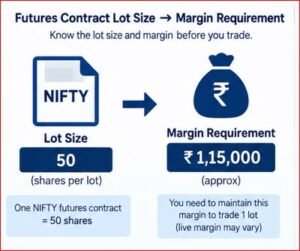
5. Does risk per trade change with leverage in F&O scalping? The risk percentage itself doesn’t change, but leverage changes how much notional exposure that percentage of risk controls. Traders scalping futures or options need to size positions based on actual capital at risk, not on the larger exposure that margin makes available.

6. Why do some scalpers use a smaller risk percentage than swing traders? Scalpers trade far more frequently, so a losing streak of a given length is statistically more likely to occur within a shorter time frame compared to swing trading. Using a smaller risk percentage per trade helps limit the cumulative damage from these streaks.

7. What happens if I don’t set a stop-loss while scalping? Without a defined stop-loss, it becomes impossible to calculate position size against a fixed risk percentage, and a single adverse move can result in a loss far larger than intended, especially with leveraged instruments.