Intraday Trading Strategies That Indian Traders Actually Use
Buy a stock in the morning, sell it before the market shuts, pocket the difference. That’s the pitch, anyway. In practice, intraday trading is one of the tougher ways to be in the market, simply because you’re squeezing decisions that a long-term investor might sit on for weeks into a window of minutes or hours.

If you’ve already got a demat and trading account open and you’re trying to figure out how to actually approach a trade — not just the theory of it — this is meant to walk you through the strategies traders lean on, why they work when they work, and the risk controls that end up mattering more than the strategy itself.
What Makes Intraday Trading Different
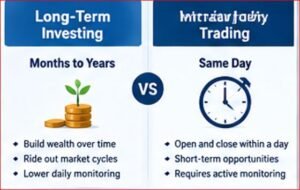
Every position you open has to be shut the same day — either you close it, or your broker does it for you near the close. You’re not trying to guess where a company will be three years from now. You’re reacting to what’s happening in the moment — news breaking, orders flowing in and out, sentiment shifting, who’s buying and who’s suddenly not.
That changes what matters. Speed of decision-making counts for a lot more here than it does in long-term investing. So does discipline around exits.. A strategy that “should” work but that you exit late or hold onto out of hope will usually lose money, even if your original read on the stock was correct.
Building Blocks Before You Trade a Strategy
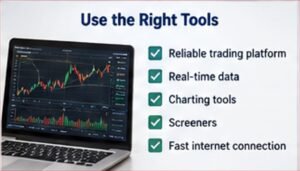
Before looking at specific strategies, it helps to understand the tools most intraday traders lean on.
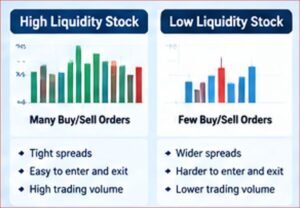
Liquidity and volume. Liquidity is part of that. Stocks with low trading volume can be tricky to buy or sell at the price you want. Simply put, there may not be enough buyers when you’re trying to sell, or enough sellers when you’re looking to buy. That’s one reason many intraday traders in India prefer actively traded stocks, including companies in the Nifty 50, Nifty Next 50, and other popular large- and mid-cap stocks.
It’s not that smaller stocks can’t move; it’s that getting stuck in one when you need to exit is its own kind of risk.
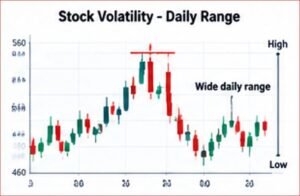
Volatility. A stock that barely moves in a day gives you little room to profit after brokerage and taxes. At the same time, extremely volatile stocks can move against you just as fast. Traders typically look for stocks with enough daily range to make a trade worthwhile, without being so erratic that stop-losses get triggered by noise.
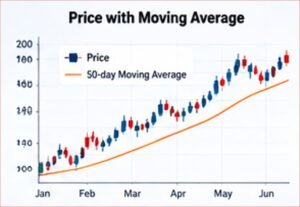
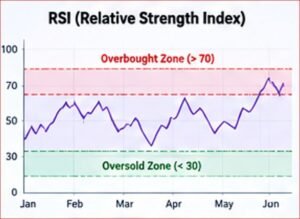
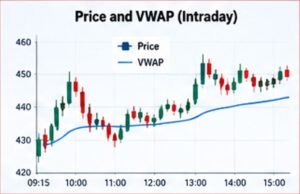
Technical indicators. Most intraday strategies use price charts rather than company fundamentals, since fundamentals rarely change within a single day. Commonly used tools include moving averages (to gauge trend direction), the Relative Strength Index or RSI (to gauge whether a stock is overbought or oversold), and VWAP, or volume-weighted average price (to see whether the current price is trading above or below the day’s average, weighted by volume).
A trading plan. And then there’s the plan. This sounds almost too obvious to mention, but it’s probably the single biggest thing separating traders who last from those who don’t: knowing, before you enter, exactly where you’re getting out if you’re right, and exactly where you’re getting out if you’re wrong.
Strategy 1: Momentum Trading
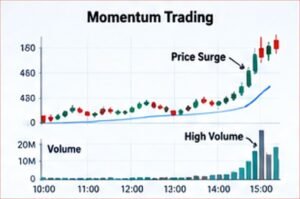
The idea behind momentum trading is straightforward — a stock moving hard in one direction, on volume well above its usual, tends to keep moving that way for at least a bit longer. Traders using this approach are usually scanning for stocks making outsized moves early in the session, often off the back of news, results, or a sector-wide rally.
This one’s harder, and most people who try it as beginners get burned at least once. You’re betting against the current direction of price, which means your timing has to be sharper than it does with a trend-following setup. Traders working reversal setups tend to lean on RSI readings — overbought, oversold — alongside candlestick signs of exhaustion, like a long wick or a range that’s clearly narrowing near a support or resistance level.. The entry usually happens once the stock has already shown some strength, not at the very first tick of movement, since early moves can reverse quickly.
The risk in momentum trading is chasing a move that’s already run out of steam. That’s why most momentum traders use a fairly tight stop-loss, since the whole premise of the trade depends on the momentum continuing — if it stalls, there’s no reason to hold on and hope.

Strategy 2: Breakout Trading
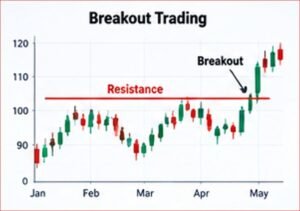
A breakout strategy looks for stocks trading in a defined price range and waits for the price to move decisively above resistance or below support, usually accompanied by a jump in volume.
The logic here is that a range represents a temporary balance between buyers and sellers. When that balance breaks, whichever side wins tends to keep pushing the price in that direction, at least in the near term.

A common mistake with breakout trading is entering too early, before the breakout is confirmed, which leads to “false breakouts” where the price pokes above resistance and then falls straight back into the range. Waiting for the candle to close beyond the level, and for volume to support the move, filters out a meaningful number of these false signals, though it never eliminates them entirely.
Strategy 3: Reversal Trading (Trading Against the Trend)
Reversal strategies try to catch the point where a stock’s short-term move exhausts itself and turns the other way. This one’s harder, and most people who try it as beginners get burned at least once. You’re betting against the current direction of price, which means your timing has to be sharper than it does with a trend-following setup.
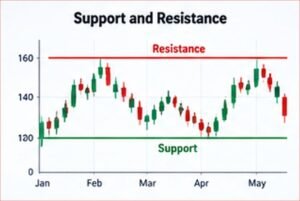
Traders working reversal setups tend to lean on RSI readings — overbought, oversold — alongside candlestick signs of exhaustion, like a long wick or a range that’s clearly narrowing near a support or resistance level.
Because you’re fighting the trend rather than riding it, position sizing and stop-losses matter even more here than they do with momentum or breakout trades.
Strategy 4: Scalping
Scalping involves taking many small trades throughout the day, each aiming for a modest price move, and exiting quickly regardless of whether the trade is a small profit or a small loss.

This strategy demands constant attention to the screen, fast execution, and a broker with low brokerage and quick order execution, since transaction costs eat into small profits much faster than they do with fewer, larger trades. Scalping is generally not well suited to traders who can only check the market occasionally during the day, since positions are meant to be held for very short windows — sometimes just minutes.
Strategy 5: VWAP Trading
VWAP-based strategies use the volume-weighted average price as a reference line for the day. Traders who believe a stock is in an uptrend look for it to pull back toward VWAP and hold above it before buying, treating VWAP as a rough support level. The reverse applies for stocks in a downtrend.
Institutions watch VWAP closely to judge whether their own large orders are getting filled at a fair average price across the day. Retail traders watch the same line for a similar reason — it reflects where a real chunk of the day’s volume has actually changed hands, not just where the price happens to be sitting.
Risk Management: The Part That Actually Decides Outcomes
It’s worth being direct about something most beginner guides gloss over: a large share of intraday traders lose money over time, and strategy selection is rarely the main reason. Risk management usually is.
Always use a stop-loss. Deciding your exit price before entering a trade, and placing the order immediately, removes emotion from the decision at the exact moment emotion is most likely to cost you money.
Size your trade to your risk tolerance, not to how confident you feel about it. A common rule of thumb is to risk only a small, fixed slice of your total trading capital on any one trade — so that a bad stretch of a few losses in a row doesn’t take a serious chunk out of your account.

Respect margin rules. SEBI has tightened margin requirements for intraday trading over the past few years, including upfront margin collection based on frameworks like VaR (value at risk) and ELM (extreme loss margin), and separate position limits in the derivatives segment. These rules are designed to limit excessive leverage, and it’s worth checking your broker’s current margin and leverage terms directly, since specific figures have changed multiple times and can vary by stock and segment.

Account for costs. Then there’s the stuff nobody likes thinking about: brokerage, STT, exchange charges, GST. All of it chips away at whatever profit you think you made. A trade that looks like a clean win on the chart can end up barely breaking even — or worse — once you actually account for costs. Scalping gets hit hardest here, since you’re paying those charges over and over on every small trade.
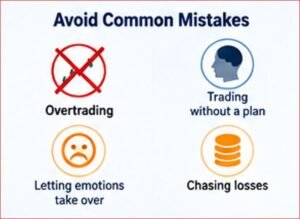
Avoid overtrading. Taking trades out of boredom or frustration after a loss, rather than because a genuine setup appeared, is one of the most common ways traders erode their capital.
A Realistic Way to Start
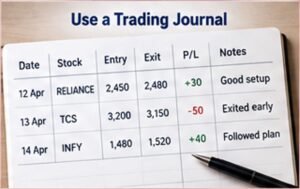
If you’re just starting out, do yourself a favor and either paper trade first or use money you genuinely won’t miss if it disappears. Don’t try to juggle five strategies at once — pick one, maybe two, and actually learn them. And keep some kind of journal. Not just “won ₹500, lost ₹800” — write down why you got in and why you got out. That habit teaches you more in a month than most guides will. Give that a few weeks or months and it’ll tell you more about what actually works for you than any strategy write-up will.
Intraday trading isn’t a shortcut to steady income, and it comes with a real chance of losing capital. If real money is on the line — money that would actually hurt to lose — give this the same level of caution you’d give any risky financial move. And if you’re not sure how intraday trading even fits into what you’re trying to do financially, that’s worth an actual conversation with a SEBI-registered adviser, not a guess.

FAQs
Is intraday trading profitable for beginners?
It can be — but most data and industry commentary points the same direction: a majority of retail intraday traders lose money over time, especially in year one. What separates the ones who do well isn’t usually the strategy. It’s risk management and discipline.
How much capital do I need to start intraday trading in India?
There’s no set minimum — it comes down to the stock price and whatever margin your broker offers. If you’re new to trading, it’s usually better to start with a small amount while you learn how the market works. Use only money you’d be comfortable losing, especially in the beginning.
So, which indicators are actually useful for intraday trading?
None of them work in isolation, honestly. Moving averages, RSI, VWAP — most traders are combining two or three of these with price action and volume, not leaning on any single signal.
How is intraday trading different from swing trading?
Intraday positions close out the same day. Swing trades run for days or weeks, chasing a bigger move over a longer stretch, with less dependence on minute-to-minute price action.

Do I need a separate account to trade intraday?
No — your regular demat and trading account with a SEBI-registered broker covers it. You’ll typically just select an “intraday” or “MIS” order type when placing the trade.

What about taxes on intraday profits?
Intraday gains are generally treated as speculative business income under Indian tax law, taxed differently from capital gains on delivery-based holdings. Rules here can shift, so it’s worth confirming the current treatment with a tax professional rather than going off a general guide.

Can I just run the same strategy every day?
Not really, no. A momentum approach that works in a trending market can fall flat in a sideways, low-volatility one. Traders who do this for a while tend to shift which strategy they’re leaning on based on what the market’s actually doing that week.