
Before you build recovery plans or buy new tools, a solid business continuity risk assessment is what tells you which risks actually deserve your attention.
An annual business continuity risk analysis involves identifying threats that could put your operations on halt, such as server outages, vendor failure and power cuts, then assessing their likelihood and severity. For trading businesses this analysis shouldn’t just be paperwork; even an outage of 10 minutes during an unpredictable session could cost over one year of insurance premiums! This guide covers not just what a BCRA means in theory but how one should actually be constructed.
I have extensive experience creating risk assessments for trading desks and fintech operations teams; most online templates available today don’t account for how risk can pop up at unexpected moments in time, like during an announcement by the Federal Reserve Bank or on Tuesday afternoons when nothing new may happen.
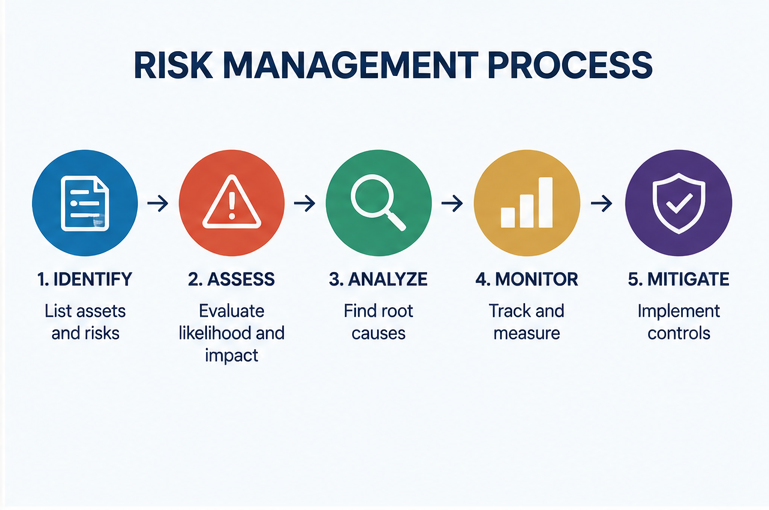
What a Business Continuity Risk Assessment Really Covers
An operational continuity risk evaluation differs significantly from general workplace safety assessments in its focus. A BCRA addresses specific threats threatening operational continuity: whether there exist threats that threaten downtime or data loss and what steps have been (or not taken) to mitigate such exposures.
At minimum, it should cover:
Threat identification involves the identification and assessment of natural, technical, human, third party and external risks (whether natural disasters are imminent, technical risks need to be managed effectively and third party risks accounted for), likelihood scoring to understand when something could possibly happen and impact scoring which accounts for financial, reputational, regulatory and operational damage, current controls that exist to reduce those risks, etc. Residual risk – is any potential threat or exposure left over after all controls have been put into effect and considered.
Most articles about risk assessment stop at “identifying risks, scoring them and moving on”. That approach leaves out crucial steps, like mapping residual risk back to decisions such as accepting mitigation measures (accept, mitigate transfering them to an independent third-party or avoidance altogether) which ultimately changes how businesses actually run.
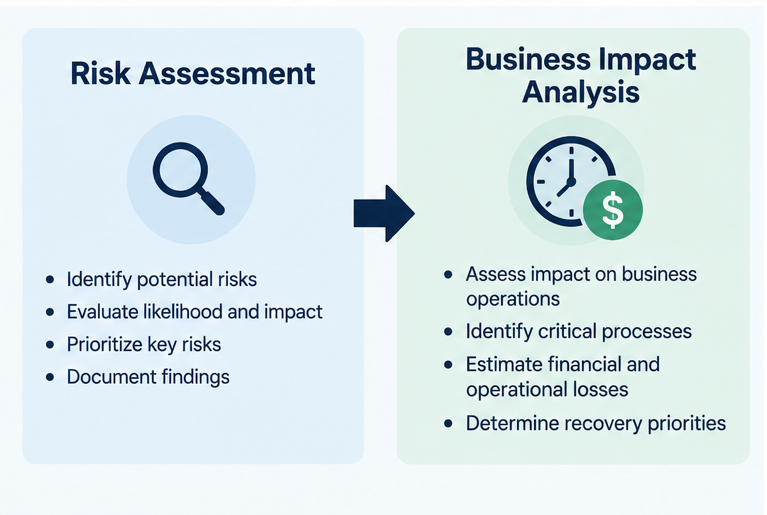
Risk Analysis vs. Business Impact Evaluation
People tend to use these terms interchangeably, leading to greater confusion during audits.
FACTOR RISK ASSESSMENT/BUSINESS IMPACT ANALYSIS (BIA) Core questions include “What could go wrong, and is its likelihood?”, as well as: If something does go wrong, how much would that cost us?” Threats/vulnerabilities; Recovery time objectives/financial impacts for each target goal/time objective will also be explored as outputs in addition to an output list with recovery priorities/time frames for action taken against any identified risk(s). Timing first and risk data as input are completed before initiating any decision-making processes.
Here is where many guides drop the ball: it is impossible to perform an effective business impact analysis (BIA) without first conducting a comprehensive risk evaluation, yet many teams choose to short-cut this process and skip straight into recovery planning without first conducting risk analyses first. That can result in elaborate failover plans being created for risks that weren’t realistic while overlooking mundane yet high-probability threats such as single point of failure in market data feeds that require mitigation plans instead.
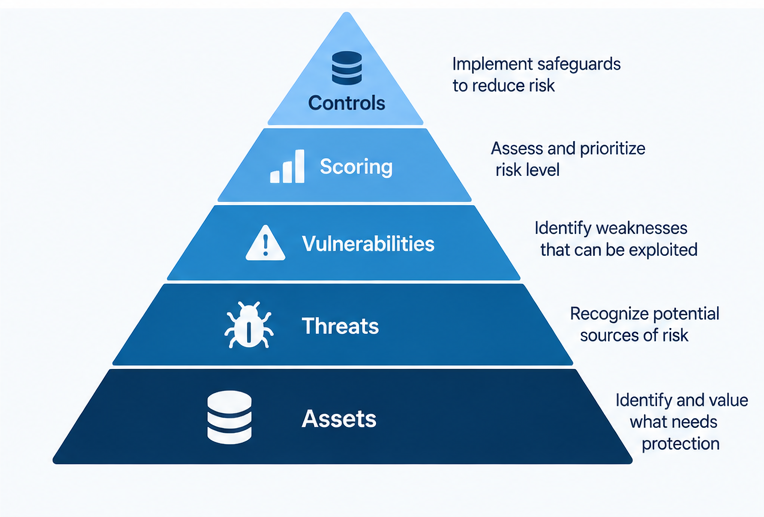
Core Components of a Business Continuity Risk Evaluation
Every effective assessment includes five elements. These components should comprise your evaluation:
- Item Inventory Report
Outline what actually powers your business: trading engines, order management systems, client-facing platforms, compliance reporting tools and key vendor relationships.
- Threat and Hazard Identification (THI)
Cyber attacks, ISP failure, data center outages, staff turnover in key roles, regulatory shutdowns or extreme weather affecting a physical office could all wreak havoc and jeopardise those assets.
- Vulnerability Analysis To what are you exposed? For instance, having your backup data center located within the same flood zone as your primary one doesn’t count as being protected as it could present another point of failure for both centers.
- Risk Scoring This methodology compares likelihood x impact using either numeric or color-coded scales, for a final estimate of risk.
- Risk Reducing Evaluation What already works to lower risks, and is its implementation effective (rather than just appearing good on paper)?
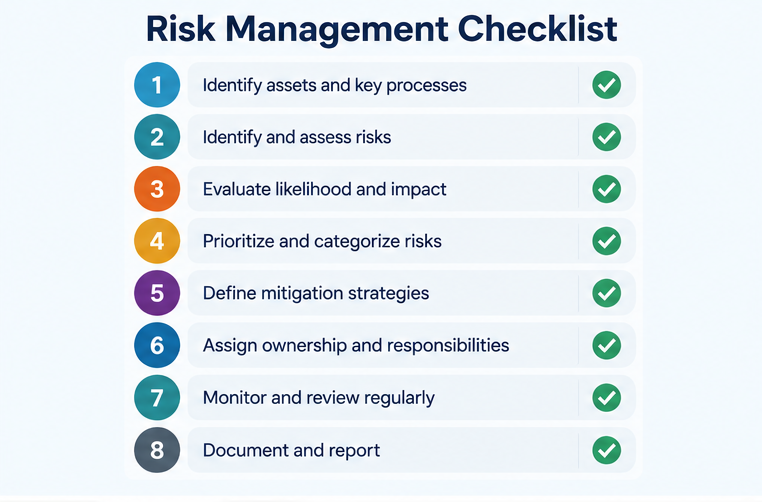
How to Do a Business Continuity Risk Assessment, Step by Step
Build an Asset Inventory First in Order to Conduct an Analyses Succinctly As soon as your asset inventory has been created, create your Assessment. Include systems, vendors, personnel and physical locations when doing this exercise. Interview the individuals responsible for running operations directly — front-office traders, compliance officers and customer support leads are key – not only IT personnel – they know where things can actually break. Trace each critical process back to its dependencies – such as your order execution system relying on one cloud region – then identify threats for each asset using both internal knowledge and external threat intelligence sources (industry ISAC reports, previous incident logs etc). Scoring likelihood and impact separately allows for accurate assessments that reveal where your real exposure lies. Once multiplied to obtain your risk rating, rank all components from highest risk down. Assign an owner and an appropriate response plan — accept, mitigate, transfer (insurance), or avoid — to each risk above your acceptable threshold. In trading operations, quarterly reviews should suffice; annually may prove too slow.
Building a Risk Analysis Matrix for Business Continuity
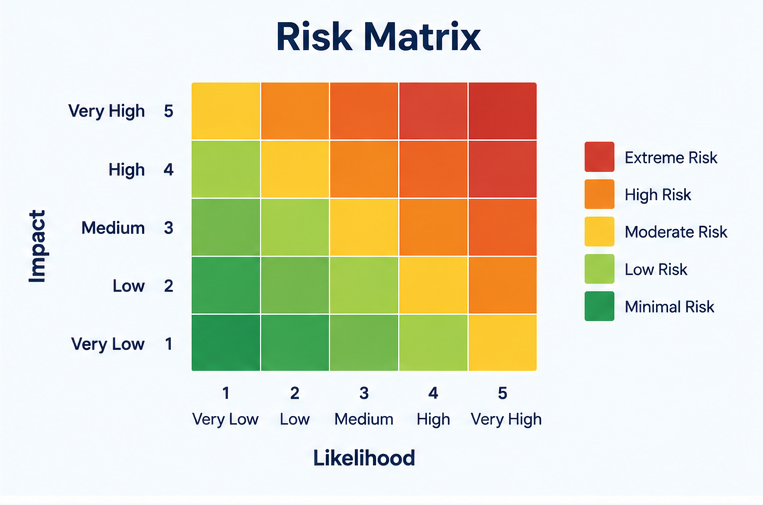
Risk matrices provide a visual way of plotting likelihood against impact so the highest-priority risks stand out instantly.
A basic 5×5 matrix should be utilized: Utilising this matrix allows one to assess: Likelihoods: Rare, Unlikely, Possible, Likely and Near Certain with regards to impact (Negligible, Minor, Moderate Major Severe);
Anything falling within the top-right corner – high likelihood and impact — gets addressed first and immediately. On an online trading platform, “primary data center outage during market hours” almost always falls into that category; an office coffee machine breaking won’t, even though someone may mention it during workshops.
One piece of advice I disagree with: many experts advocate keeping a 5-x-5 matrix simple; I find this too coarse when applied to trading operations specifically, where even 2-minute outages versus 20-minute outages during active sessions have dramatic financial ramifications; yet 5×5 matrix often lumps them all together under “moderate.” My 7-point impact scale approach has proven more successful at providing clarity.
What to Include in a Business Continuity Risk Assessment Template
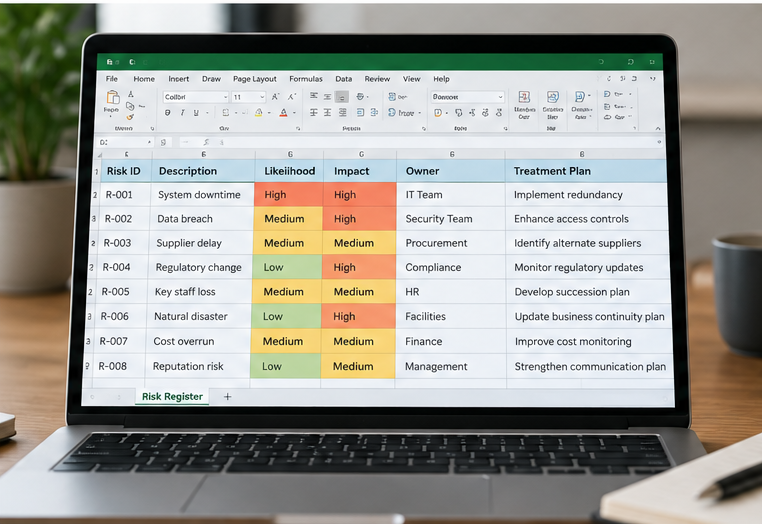
When creating or downloading a template — PDF or spreadsheet — make sure it features at least these columns:
Risk ID | Description (technical, human, third party, environmental, regulatory) When assigning risks they must first provide their identification number as well as detailed descriptions describing any applicable categories (technical, human, third-party environmental regulations etc). From there they need to assign likelihood scores (likelihood score = chance score + impact score x odds score), impact scores as a way of rating overall risk scores as well as existing controls rating residual risks from past actions taken and ownership or Risk Owner. Treatment Plan (Accept, Mitigate, Transfer and Avoid) Review Date Unfortunately, many free templates online omit the “Risk Owner” column completely, rendering their assessments without an accountable owner to update as nothing more than documents with outdated information.
A Business Continuity Risk Assessment Example, Walked Through
Imagine running a small trading platform with around 40,000 active accounts; your primary risk list might look something like this:
Risk: Regional Cloud Provider Outage Likelihood: Probability (an outage occurs every 1-2 years industry-wide); Impact: Severe (complete trading halt, client trust damage and potential regulatory investigation are possible due to such outages); Current Controls: Single Region Deployments with no automated failover systems Residual Risk is High ; thus mitigating this by implementing multiregion failover within two quarters as treatment
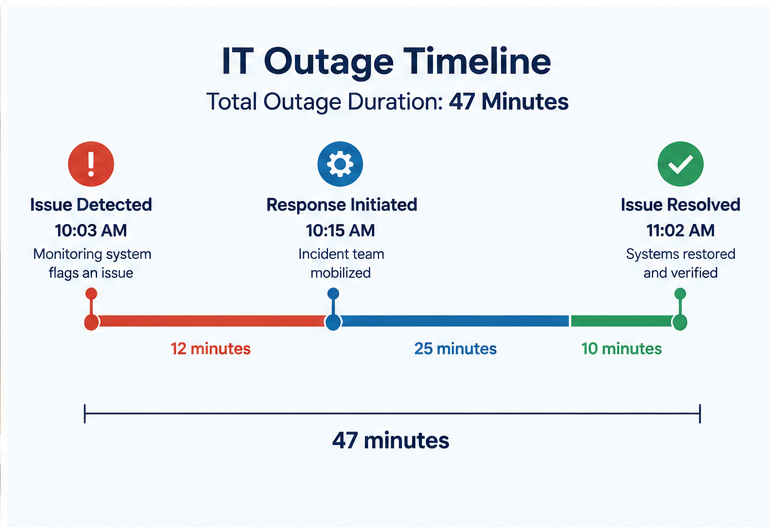
One mid-sized platform learned this the hard way during a regional cloud outage several years back: during high volatility sessions during an outage in their order system was down for 47 minutes during an intense high-volatility session without malicious attack or unusual event; just a single point of failure nobody had flagged as “severe,” possibly because they’d never encountered it before. On further investigation they realized their risk had actually been assessed eight months earlier as “moderate,” only for it never to be revisited later; that lesson taught them: an assessment not reviewed regularly will create false confidence among staff that causes them all the more often than no assessment could ever do so alone!

Business Continuity Threat Evaluation: Which Threats Matter Most
Threat assessments provide a narrower lens upon which to analyze risk; their primary focus being the identification and classification of threats before scoring is applied.
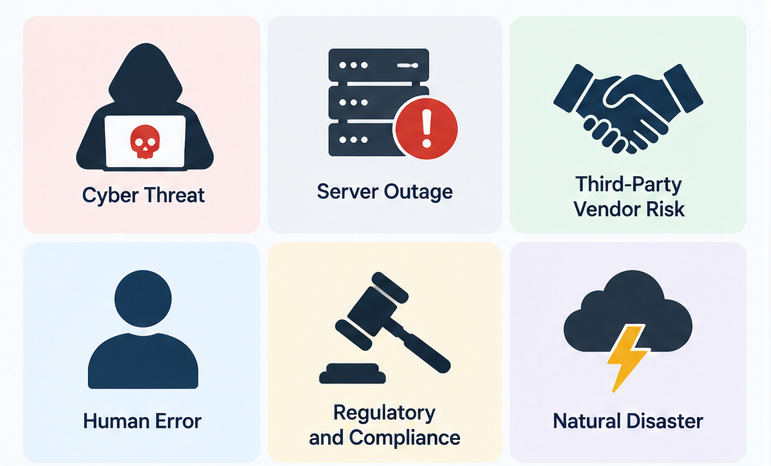
Threats affecting an online trading business typically fall into three distinct categories.
Cyber threats — DDoS attacks during high-volume trading windows, credential stuffing of client accounts and ransomware infections into internal systems
Third-party/vendor threats: market data feed disruption, payment processor downtime and KYC/AML vendor failure Human threats: key-person dependency issues, insider errors or mass resignation during critical periods And regulatory threats can include sudden compliance changes, license suspension and forced trading halts Environmental risks — power grid outages or natural disasters which affect physical offices or data centers
Threat assessments must be updated more often than risk evaluations — I suggest every quarter for anything cyber related, since threats change faster than many companies’ review cycles can handle.
Common Risks for Online Trading Platforms
Trading businesses face risks that don’t appear on standard business continuity checklists:
Market data feed latencies or interruptions during active trading hours; order execution engine failure during high-volume loads such as flash crashes (flash crash-style spikes); payment gateway or custodian bank downtime which affect withdrawals; regulatory reporting system malfunction ahead of a filing deadline Client authentication system outage locking users out during volatile markets, third-party liquidity provider disconnections, compliance staff shortage during an audit window
If your risk assessment template doesn’t include an explicit category for trading-specific operational risk, then you are using an approach tailored for another kind of company.
Business Continuity Risk Management Framework: Implementation Strategies
An assessment alone is just an overview; having an organizing framework ensures its sustainability.
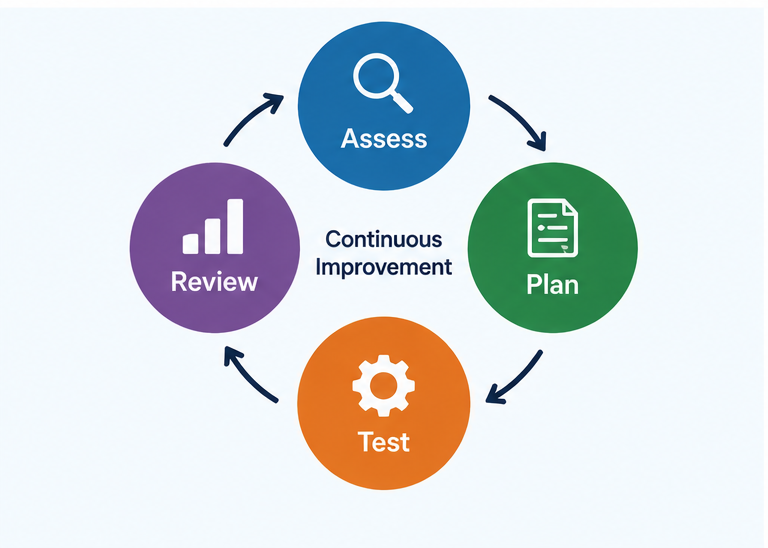
An effective business continuity risk management framework typically encompasses four ongoing stages.
Assess – the process outlined above of risk evaluation is followed. Plan – to create specific response and recovery procedures for high priority risks (i.e. those of greatest priority). Test – run tabletop exercises or failover drills as opposed to just theoretical walkthroughs before updating assessments accordingly (recent tests have revealed more or less than expected during tabletop exercise sessions, for instance). Review – to update assessments accordingly as new testing findings come forward (such as how successful tabletop exercises actually proved).
Testing is something many businesses try to put off – uncomfortable and time consuming; often revealing embarrassing gaps – but an untested continuity plan is just guesswork masked as planning. I would much prefer seeing companies execute one real failover drill a year instead of having a perfect 40-page continuity document which has never been stress tested.
PDF or Excel for Your Risk Analysis? Here Are Your Options
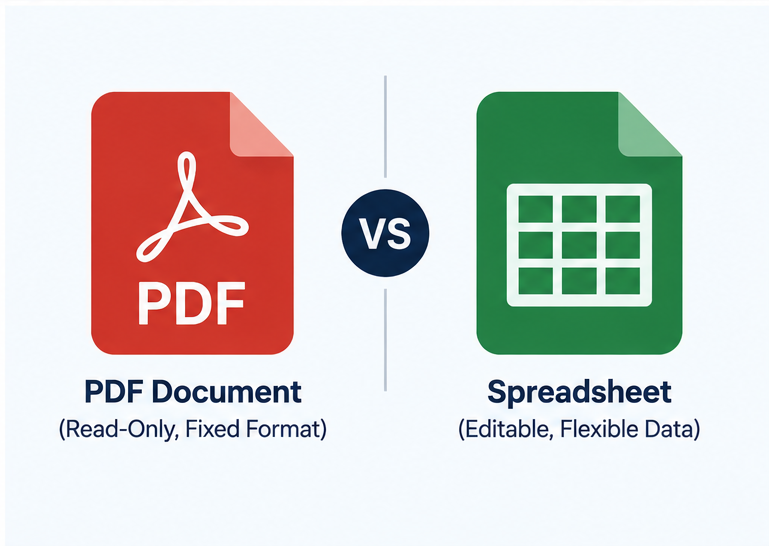
PDF formats work effectively when it comes to:
Distributing finalized assessments to auditors, regulators, or board members. Archiving point-in-time snapshots for compliance records. And any time when locked and non-editable versions may be needed.
Format of an Excel/spreadsheet file works better for:
Your risk team continuously updates a living document: sorting and filtering by risk score, category or owner and building the risk matrix with conditional formatting to enable quick visual scanning of risk information.
My advice would be: keep the live version in a spreadsheet (or GRC tool, if applicable) and only export PDF versions when necessary for specific audiences. Teams managing risk registers exclusively via PDF typically end up letting it fall by the wayside because editing PDF documents is too cumbersome a task; editing is usually put off until later on in life.
Career Paths in Business Continuity Risk Management
Business continuity risk management has emerged as its own distinct profession within financial services, particularly within trading and fintech environments. Common titles for those practicing this craft in this space include Business Continuity Analyst, BCM Program Manager, Operational Resilience Lead and Risk & Resilience Consultant; in trading/fintech specifically these roles often sit closer to technology/compliance teams than corporate risk departments as infrastructure-related risk is prevalent throughout their systems – DRI International offers two relevant certifications such as Certified Business Continuity Professional (CBCP), while ISO 22301 Lead Implementer credentials can add further specialization within these two disciplines.
Mistakes That Derail Business Continuity Plans
Some repeated patterns exist:
Treating risk assessments like compliance exercises instead of living documents: Scoring risks on how awkward they’d be to discuss, rather than their actual likelihood and impact; leaving “risk owner” fields blank or assigning responsibility to teams instead of individuals No One to Help When the Plan Is Faltering Failing to test their plans under conditions that resemble actual bad days — most drills occur during relatively quiet times and do not give an accurate reflection of performance under real market stress Constructing an attractive matrix but then not updating it after each infrastructure change
No exotic errors here — only boring maintenance work often gets neglected until it is too late and costs far more than initially estimated.
Realize this Takeaway A business continuity risk analysis only truly pays dividends when someone owns each risk and scoring is conducted honestly in line with reality rather than to meet comfort thresholds, while regular tests and updates take place. So make a list, assign owners for each one, conduct your drill – then set an annual reminder date!
Business Continuity Risk Assessment FAQ
What is a Business Continuity Risk Analysis (BCRA)? It involves the process of identifying threats to the operations of your business and scoring their likelihood and damage severity before documenting controls that reduce those risks.
How is Risk Analysis Differ from Business Continuity Plans (BCPs)? A risk evaluation assesses and ranks threats; on the other hand, business continuity plans outline specific plans and processes to respond and recover from these identified threats once identified.
How frequently should business continuity risk assessments be reviewed? For trading and fintech operations, quarterly updates may be appropriate given their fast-changing infrastructures and threats landscapes; annually reviewed assessments tend to leave gaps when it comes to technology-related threats.
What should a business continuity risk assessment matrix include? At minimum, this matrix should consist of plotting two scales together–namely likelihood and impact–with identified risks placed into it according to their combined score. Color coding such as green/yellow/red makes prioritizing key risks easier.
Does any business continuity framework (like ISO 22301 templates) offer free business continuity risk evaluation templates for download in PDF or spreadsheet form? Yes – most business continuity frameworks (such as those aligned to ISO 22301) do provide these documents free-of-charge in downloadable versions that include risk owners columns. Unfortunately, many free templates for risk evaluation do not feature them!
Who’s responsible for conducting a business continuity risk evaluation? Typically a business continuity manager or risk officer leads this effort; however, for more accurate assessments it may benefit to include direct input from operational teams — IT, compliance and front office — who know where potential weak points lie.